How Ali improved her energy and overcame digestive and skin problems
Ali recently had a remarkable health transformation.
She contacted us in summer 2021 to see if we could help with her digestive, energy, mood, sleep and skin problems.
Four years earlier, Ali had planned to go travelling and had some vaccinations to protect against exotic infections.
Unfortunately, the vaccinations seemed to trigger some side effects.
Following the vaccinations, she developed some difficulty with her moods, followed by a sudden downturn in her digestive health.
By the time she reached out to us, Ali – in her own words – was experiencing the following symptoms:
- A bloated tummy
- Loose stools and diarrhoea
- Passing blood and mucus in stools
- Feeling sick and having an uncomfortable stomach on a morning
- Not always having a good appetite
- Gurgling in stomach after eating
- Skin is really bad around my chin / neck area
- Feeling anxious and depressed for the past four years
- Feeling tired and yawning a lot
- Feeling weak
- Feeling cold a lot of the time
- Gradually losing weight despite a good diet
- Poor quality of sleep––waking up in the night and struggling to fall asleep again
- Struggling to wake up in the morning
- Wanting to stay in bed and sleep
- Bones clicking a lot in shoulders and back
Initially, the symptoms seem to be unrelated, but we usually find in these cases that they are all connected.
In fact, Ali’s case is a beautiful example of how a set of many worrying and debilitating symptoms can be the result of just a small handful of underlying causes.
Ali’s stool test
Because Ali was experiencing digestive symptoms, it was a no-brainer to run a home stool test to see what might be going on in her digestive tract.
We often see a lot of “bad bugs” in stool test results but, surprisingly, Ali’s stool test result did not detect any major bacteria, parasites or yeast/fungi.
However, you can see below that three markers were very high: occult blood, secretory IgA and calprotectin.
These are “digestive chemistry” markers that help us understand how a person’s digestive and immune systems are functioning.
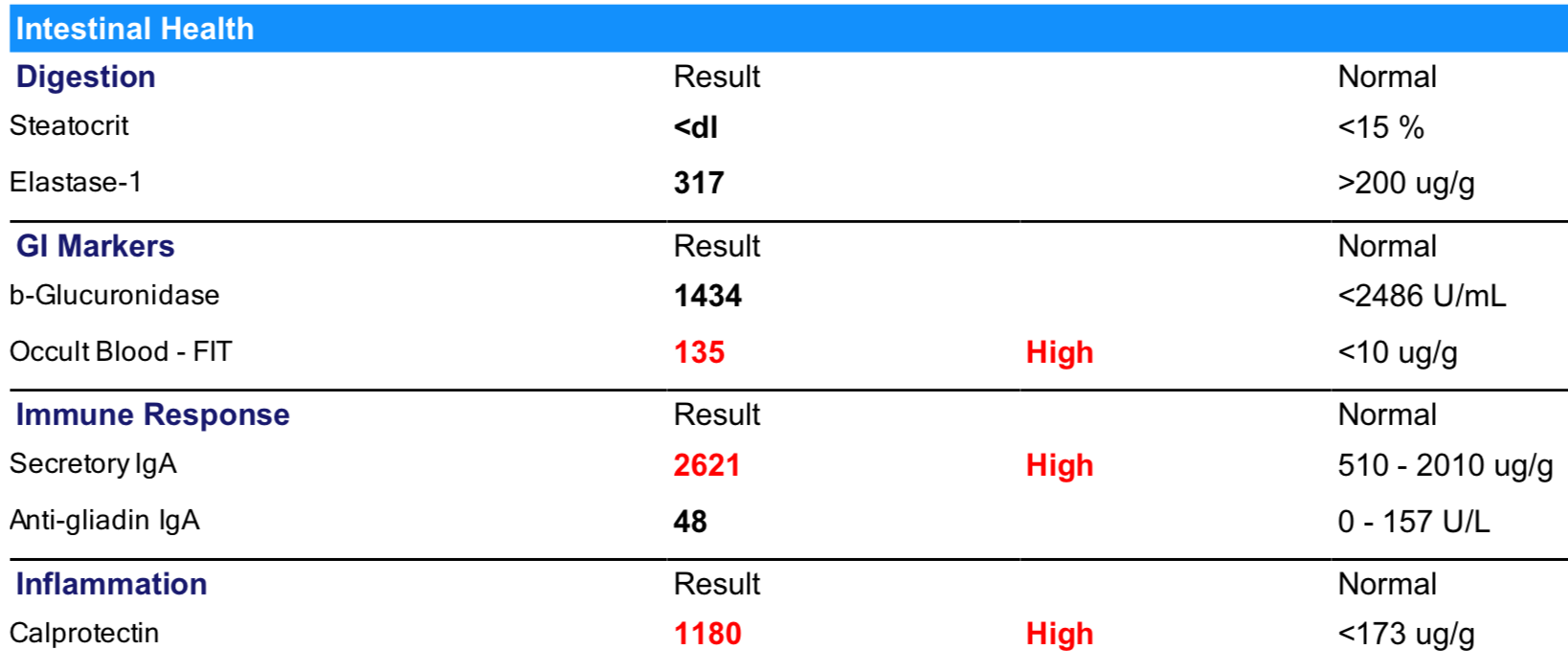
Secretory IgA is a marker of immune activity within the intestine. A high secretory IgA level means there is excessive immune activity, which tends to generate inflammation.
Calprotectin is a marker of the intestinal inflammation level. It is elevated in inflammatory bowel conditions such as ulcerative colitis and Crohn’s disease.
Occult blood reflects the detection of blood in the stool. Ellie had obviously seen blood in her stool, so this stool test result was not surprising to us.
Medical opinion
Ali had seen a gastrointestinal specialist, who performed a colonoscopy. The test revealed inflammation and some ulcers at the lower end of her colon.
The medics were reluctant to provide a definitive diagnosis, but I suspected Ali had a case of ulcerative colitis, which is classified as an inflammatory bowel disorder (IBD).
The calprotectin, secretory IgA and occult blood results in her stool test all supported this conclusion.
Al’s blood test results
Ali had done a blood test with her doctor and surprisingly did not flag any problems.
When we looked at the result with a different angle of interpretation, we detected some important imbalances.
Ali’s white blood cells were imbalanced, indicating a “skewed” immune system response.
In technical terms, it appeared that she had a “Th1 dominant” immune response, which is common in inflammatory bowel disorders like colitis.
- Neutrophils 47% (too low – should ideally around 60%)
- Lymphocytes 37% (too high – should ideally around 30%)
- Monocytes 11-12% (too high – should be around 7%)
Ali’s inflamed digestive system also seemed to have compromised her ability to digest food and absorb nutrients.
- Her protein markers were both low indicating borderline protein deficiency
- Her iron level were borderline low
- The vitamin B12 level was way too low
- Finally, Ellie’s vitamin D level was also borderline low
Treatment options
Ali and I had a good chat about treatment options. We discussed which medications the doctors would likely recommend and looked at their potential benefits and drawbacks.
Medical treatments for inflammatory bowel diseases include strong anti-inflammatory drugs such as steroids.
I advised that these can be very helpful, but that they don’t address the underlying cause and may also lead to problems further down the line.
Ali decided that she would prefer to try a nutrition and functional medicine approach first, in full knowledge that the medical approach was available as a back-up.
The functional medicine approach to IBD
There isn’t really a standard, one-size fits all approach to IBD––the specific approach we take depends on each person’s individual situation and lab test results.
Put simply, different people may require different approaches despite their diagnoses being the same.
In Ali’s case, I immediately recommended three supplements for Ali.
- Vitamin D drops (helps to regulate the immune system)
- Vitamin B12 lozenges (because she was low in B12)
- Desiccated beef liver capsules (to provide iron and B vitamins, which she was low in)
We discussed diet and agreed that a gluten and dairy-free approach would be wise.
I also recommended a reduced nut and seed consumption because nuts and seeds contain lectins, oxalates, and other potentially problematic substances.
These foods can all irritate the intestinal lining and may trigger immune responses and inflammation.
Initial results from the protocols
Within a relatively short space of time, Ali noticed some changes for the better.
Although we still had a long way to go, Ali’s energy and mood picked up, and her digestion began to settle down.
Next step: immune-balancing supplements
Next, we introduced four supplements:
- Curcumin
- Resveratrol
- Vitamin A
- Fish oil
The compounds in these supplements help to dampen an out-of-control immune response and reduce inflammation
Vitamin D, which Ali was already taking, is also a potent modulator of the immune response.
[A technical point for those who are interested: specifically, these substances suppress pro-inflammatory processes involving NF-kB, TNF-alpha, IL-6, STAT3 and other biochemicals.]Put more simply, they throw a “damp blanket” on the immune response, thereby reducing inflammation.
Hormone support
Ali noticed that although she was feeling better overall, she had 3-4 days of feeling low just before her period.
This is a common symptom in the cluster of maladies known as “PMS”.
PMS is usually caused by hormonal or nutrient imbalances, which may themselves be caused by inflammation and digestive problems.
I recommended some hormonal support in the form of herbs which gentle nurture the actions of oestrogen and progesterone.
Next steps: trans-cutaneous vagal nerve stimulation
We also added a technique called tVNS, which is short for transcutaneous vagal nerve stimulation. It involves using a TENS machine with an ear clip and is very easy to do.
The machine sends a very gentle electrical current into the left ear, which very gently stimulates the vagus nerve.
Research has shown that once it has been stimulated, the vagus nerve tells immune cells in the spleen, liver and intestine to stop making pro-inflammatory substances such as TNF-alpha and IL-6.
In this way, tVNS is anti-inflammatory.
It doesn’t work for everyone, but in Ali’s case, it was very helpful.
Overall results
Ali has experienced massive improvements in all the symptoms listed at the top of this article.
Indeed, most of the symptoms have completely gone away.
Her energy, sleep, skin, and mood have improved, and her digestion is much more settled. Her stools are well formed, and she is not passing mucous or blood.
In fact, in a recent email, Ali wrote:
“My dad is overwhelmed with relief and told me this evening he feels like he ‘has his daughter back.”
“I haven’t been taking any supplements for about 1 month to 6 weeks now, including the hormone supplements and I generally feel great. My skin is the best it has been in years, and I am not having the painful breakouts and it’s calmed down. I’ve also gained weight, being almost 8 stone and when I weighed my lowest last year, I was around 7 stone 3, so I’ve almost gained a stone, which is the most I’ve weighed in years.
I’ve had some really nice compliments from friends / family on how much better I look, seem and the ‘old Ali’ is coming back, so that’s been really rewarding. Thanks again so much for your help, I really don’t think I could have got to where I am now without your knowledge and guidance.”
Can we assist you?
Ali’s case is a great example of how a certain trigger event – in this case vaccination – can cause unexpected and unwanted problems.
Although the case seemed very complex, all we needed to do was run the right lab tests and figure out what was going on “under the hood.”
The two lab tests we needed were a) a blood test with a different interpretation from the ones a doctor would usually provide, and b) a stool test.
As Ali said in her kind email to us, without a detailed exploration of her digestive health and blood test, she may not have been able to make such great progress.
We don’t take credit. Rather, we’re indebted to the labs and technicians who make the lab testing possible.
We would love to help if you are struggling with symptoms of any kind, particularly those related to digestive health, energy, mood, skin, sleep, hormones, allergies or other immune problems.
A stool test and initial consultation is a great starting point.
Ordering a stool test and consultation package from us is 100% risk-free – if you run a stool test and it does not reveal the reasons you’ve been feeling unwell, we’ll refund your money.
You can’t lose.
Just click on the link below, and learn how easy it is to get started.
Click here to learn more about a stool test, or to order one.
Look out for the next case study, and we’ll talk to you soon.
Best wishes,
Dave & Jack
Disclaimers
The information contained herein is for educational and informational purposes only and should NOT be used as a substitute for the advice of a health care provider.
These statements have not been evaluated by the FDA. None of the products offered herein are intended to diagnose, treat, cure or prevent any disease. If you are pregnant nursing, taking medication, or have a medical condition, consult your physician before using any of the products offered herein.
Medical disclaimer: Any health information provided on this website should first be vetted by your own physician. Do not attempt to change your diet or any other activity related to your health based on information from this site unless you have first cleared it with your own medical doctor.
Results disclaimer: Any results, testimonials and comments published on this site are in no way a suggestion or guarantee of results. Your level of success in getting results similar to any success story on this site depends on several factors: your biochemical individuality, diet, background, motivation, commitment, and actions. Clearly, results vary from person to person.
2018 © Copyright by Health For The People Ltd. All Rights Reserved. | Dave Hompes | Google + | Sitemap | Terms | Privacy | Cookie Policy | Web Design Company