


In this post, which continues my series detailing how H pylori and heart disease are connected, we’ll explore the connection between H pylori and oxidative stress.
So far in this blog series we’ve looked at how in some people H pylori infections have the ability to:
If you have not yet read the above posts, I recommend you do so before you read this one, as it will make more sense that way.
In this post we’ll specifically look at the relationship between H pylori and oxidative stress, which is a process that underpins many symptoms and diseases.
Barry Marshall and Robin Warren, both MDs, were awarded the Nobel Prize in Physiology or Medicine in 2005 when they proved that H pylori infections cause stomach ulcers.
A sentence in the press release for this award states that, “H pylori always causes inflammation”.
… and wherever there is inflammation there is this thing called oxidative stress.
Your body is very smart.
When it senses an invader such as a parasite, bacterium or virus, it initiates an inflammatory response.
The inflammatory response is necessary and is the means by which your immune system fights off invaders, deals with toxins, injury and trauma.
Over the short-term, the inflammatory response is necessary and very, very useful.
However if your body gets stuck in the inflammatory response, you’re in trouble because inflammation underpins virtually all known symptoms, disorders and diseases.
Importantly, we know that heart disease is an inflammatory process.
Thus, anything that causes inflammation – toxins like mercury and lead, or H pylori, for example – have the potential to contribute to heart disease.
Now, wherever there is inflammation, there is also oxidative stress.
These two processes go hand-in-hand and are virtually never exclusive of one another.
Oxidative stress is a term used to describe the negative effects of molecules called free radicals or reactive oxygen species (ROS) on body tissues.
These free radicals bounce around like pinballs in a pinball machine, bashing into cell membranes, inner membranes, proteins and even DNA.
An increased level of oxidative stress is associated with aging and virtually all of the degenerative diseases, including heart disease.
The image below shows how inflammation and oxidative stress can affect different parts of your body.
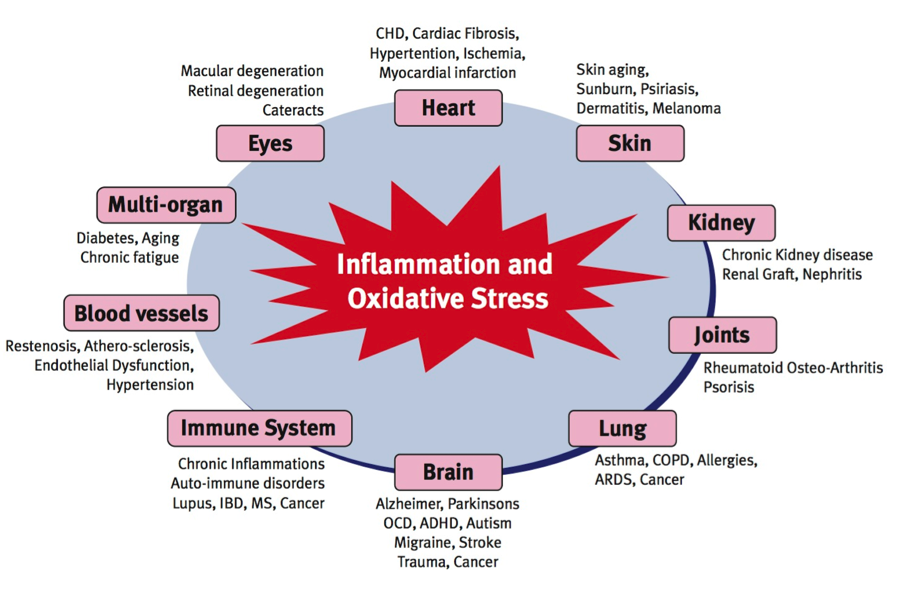
Your body combats inflammation and oxidative stress with substances such as hormones (e.g. cortisol) and nutrients.
Nutrients called antioxidants, which I’m sure you have heard of, are very important.
Antioxidants include vitamins A, C and E, coenzyme Q10, selenium and plant compounds such as flavonoids, carotenoids and resveratrol.
Unfortunately, a lot of people we consult are not eating nearly enough of these nutrients and are often shown to be antioxidant-deficient in lab tests.
H pylori causes oxidative stress, and H pylori causes inflammation.
Doctors acknowledge the inflammation in your stomach – known as gastritis – but they don’t tend to realize that this inflammation can spread round your body.
Stomach inflammation (gastritis) can spill over and lead to inflammation in other areas.
This is one reason why H pylori is associated with things like:
A 2006 study investigated the relationship between insulin resistance, H pylori and oxidative stress.
Researchers enrolled 55 subjects with H pylori and 48 non-H pylori control subjects.
In both groups, measurements for insulin resistance, serum total antioxidant capacity, total oxidant status and oxidative stress were taken:
The researchers concluded that:
“Insulin resistance seems to be associated with increased oxidative stress in H pylori infection. Further studies are needed to clarify the mechanisms underlying this association.” 29
H pylori seemingly has the ability to increased oxidative stress, leading to a reduction in antioxidant levels.
In another study, researchers wanted to elucidate the mechanisms by which CagA H pylori strains may contribute to heart disease.
They studied 159 patients with coronary heart disease and divided them into three groups:
The following results were reported:
Here is the study conclusion:
“More serious coronary atherosclerosis was observed in CHD patients with CagA H pylori infection. CagA H pylori infection might be involved in coronary atherosclerosis by modifying serum lipids, enhancing LDL oxidation and activating the inflammatory response.”30
C-reactive protein – discussed in the next post – and increased levels of oxidized LDL cholesterol evidence the presence of inflammation and oxidative stress.
What these researchers are saying in their conclusion is that CagA H pylori strains may enhance heart disease by increasing oxidative stress, which is represented by elevated oxidized cholesterol, C-reactive protein and apolipoprotein-B in the blood.
A recent study examined oxidative stress in school children.
The study team divided school children into different groups:
The researchers found that oxidative stress indicators were elevated in children who were infected with H pylori.
They also reported that chronic oxidative stress may cause the breakdown of protein in children’s bodies, which may explain why some people experience weight loss when they have H pylori.
Here is the study conclusion:
“An increased level of oxidative stress was found in H pylori infected school children. Furthermore, the findings from this study indicate that prolonged oxidative stress may enhance protein degradation in children.” 31
A further study, this time conducted in Saudi Arabia, also looked at the relationship between H pylori and oxidative stress.
This time, rather than simply examining whether patients with H pylori had more oxidative stress than uninfected individuals, the research group wanted to see if oxidative stress levels came down following H pylori eradication.
The researchers took 20 anemic patients who were infected with H pylori and divided them into two groups:
Changes in various parameters were noted in both groups and were compared with 15 control subjects.
Following H pylori eradication, the team found that markers for oxidative stress decreased and markers for antioxidant status increased.
Furthermore, the team noted that iron status improved in patients who eradicated H pylori compared with patients who only took iron supplements, indicating that H pylori affects iron status.
The team reached the following conclusion:
“The findings from this study indicate that treatment for both anemia and H pylori infection is required for lowering the oxidative stress markers, which synergistically bring about an appropriate correction of anemia soon in these patients.” 32
According to research cited by Tom Levy, MD in his books, antioxidants – especially vitamin C – are used up at a greater rate during infections, H pylori.
A handful of studies have examined the relationship between H pylori and vitamin C status.
Vitamin C is a potent and essential antioxidant. It is used up very quickly when the body is under stress from infection, toxicity and inflammation.
Nobel laureate Linus Pauling asserted that vitamin C deficiency alone may be one of the most important risk factors for the development of heart disease.
Vitamin C acts as an antioxidant, supports collagen formation and reduces dangerous cholesterol molecules called “Lp(a)” .
In a 2003 study published in the medical journal Gut, researchers looked at three groups of patients to note associations between H pylori, gastric pH, iron deficiency anemia and ascorbic acid (vitamin C) levels.
It is important to note that the higher the gastric pH, the less acidic the stomach environment is, indicating a reduction in stomach acid production.
This, in turn, prevents proper digestion and nutrient absorption.
The researchers divided study subjects into three groups:
Both of the H pylori infected groups had significantly lower plasma ascorbic acid levels.
In other words, they had lower circulating levels of vitamin C.
Patients with iron deficiency had significantly lower stomach acid levels and the researchers concluded reduced acidity probably resulted in impaired iron absorption (this is well established in the research literature).
Vitamin C enhances iron absorption, so the lower iron levels observed in infected people may have been partly due to low levels of serum vitamin C.
It was not clear why some H pylori infected individuals developed iron deficiency anemia and others did not.
The researchers concluded:
“Patients with unexplained iron deficiency anemia and H pylori gastritis present concomitant changes in intragastric pH and ascorbic acid that may justify impaired alimentary iron absorption and consequent iron deficiency anemia.” 33
In another study carried out over a five-year period, multiple stomach biopsies were taken from 452 children.
H pylori infection was detected in 112 subjects.
Vitamin C concentrations in whole blood, plasma, and gastric juice were measured.
Vitamin C levels in whole blood, plasma, and gastric juice were negatively correlated with the severity of H pylori infection.
In other words, the more severe the H pylori infections were, the lower the vitamin C levels.
The researchers concluded:
“The data demonstrate that vitamin C levels in whole blood, plasma, and gastric juice and the gastric juice pH in Korean children are closely related to the severity of H pylori infection.” 34
In 2011, a team of researchers in the U.S. examined the relationship between H pylori infection and several key nutrients.
Blood collected from 310 subjects was assayed for levels of several key nutrients:
The researchers found that mean serum levels of all micronutrients assayed were lower among people with H pylori.
The differences were statistically significant for βeta-carotene, folic acid and retinol.
Moreover, individuals who had CagA H pylori strains had even lower mean levels of nutrients, particularly β-carotene, folate, total carotenoids, and retinol.
Beta-carotene and retinol are antioxidants, while folate is needed to clear homocysteine – another heart disease risk factor – from the blood.
The researchers concluded:
“These results provide support for the hypothesis that H pylori infection impairs nutrient absorption and suggest a need for future studies to explore the role of H pylori infection on nutrition and gastric cancer risk in this high-risk population.” 35
A meta-analysis done on antioxidants, H pylori and oxidative stress
An important meta-analysis with pooled data from 52 studies revealed significant associations between H pylori and vitamin C levels, as well as vitamin B12.
Levels of both nutrients improved following successful H pylori eradication, indicating H pylori infection has a direct influence on vitamin C and B12 status.36
H pylori infections – especially the CagA strains – cause oxidative stress and deplete key antioxidant nutrients such as vitamin C, carotenoids and possibly vitamins A and E.
They also deplete vital nutrients such as folic acid, B12 and iron, a fact that is well established in the H pylori research community.
The net effects of these nutrient deficiencies on your health can be far-reaching and may include:
Disclaimers
The information contained herein is for educational and informational purposes only and should NOT be used as a substitute for the advice of a health care provider.
These statements have not been evaluated by the FDA. None of the products offered herein are intended to diagnose, treat, cure or prevent any disease. If you are pregnant nursing, taking medication, or have a medical condition, consult your physician before using any of the products offered herein.
Medical disclaimer: Any health information provided on this website should first be vetted by your own physician. Do not attempt to change your diet or any other activity related to your health based on information from this site unless you have first cleared it with your own medical doctor.
Results disclaimer: Any results, testimonials and comments published on this site are in no way a suggestion or guarantee of results. Your level of success in getting results similar to any success story on this site depends on several factors: your biochemical individuality, diet, background, motivation, commitment, and actions. Clearly, results vary from person to person.
2018 © Copyright by Health For The People Ltd. All Rights Reserved. | Dave Hompes | Google + | Sitemap | Terms | Privacy | Cookie Policy | Web Design Company